


Frequent Decision Regret Signals Need for More Flexible Network Investment Planning
Gartner distinguishes between two types of supply chain operating challenges. Turbulence refers to ongoing, expected instability such as fluctuating demand, labor variability, and cost swings that slow or complicate the flow of goods. Disruption, by contrast, is a major unexpected event. While large disruptions draw attention, Gartner found that day-to-day instability erodes margins and more consistently drives up costs in areas such as expedited shipping, extra inventory, and overtime labor (see Figure 1).
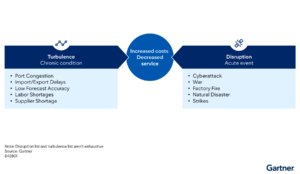
Source: Gartner (July 2026)
The New Math of Network Investment Decisions
- Operational adaptability: The quantifiable cost of absorbing ongoing supply chain friction, such as premium freight, excess buffer stock, and overtime labor and changeover costs required to handle erratic schedules.
- Network adaptability: The fixed or semifixed costs associated with structurally diversifying the network to reduce risk exposure, like the expense of qualifying and maintaining multiple supplier sites.
- Capital adaptability: The time and money required to pivot the supply chain infrastructure in the future to respond to high-impact disruptions and changing operating environments.
Traditionally, supply chain leaders focused on the one-time and ongoing costs of a network investment, without explicitly incorporating the variable costs associated with managing chronic turbulence.
To improve decision outcomes in this environment, Gartner identified two approaches for supply chain leaders:
- Quantify the hidden cost of supply chain turbulence using the new math: Move beyond static models by explicitly measuring the financial impact of ongoing volatility and friction.
- Consider the half-life of your network strategy: CSCOs should be prepared to reverse, stop, or repurpose investments. Define the longevity of network designs and when to pivot or terminate a project.
“Revisiting a decision in itself shouldn’t be seen as a failure,” said Forman. “In a volatile environment, the ability to stop, reverse, and repurpose an investment can prevent larger losses. Organizations that treat network decisions as adaptable, rather than fixed, are better equipped to protect margins and respond to change.”