


Despite Lack of Success, Investment in AI Continues to Accelerate
A Gartner survey from January-April 2026 of 1,303 respondents from organizations with enterprisewide annual revenue of at least $50 million in fiscal year 2025 found that, despite this lack of success, investment in AI continues to accelerate. Eighty-five percent of functional leaders plan to increase spending in 2026 after dedicating an average of 12% of their functional budgets to AI in 2025.
“This lack of financial visibility heightens risk as spending accelerates,” said Tina Nunno, Distinguished Vice President & Gartner Fellow. “Without disciplined measurement tied directly to business outcomes, organizations risk wasted resources and unmet expectations.”
High performers – companies that constantly track ROI of AI initiatives, treat AI as a portfolio of value and regularly assess project performance and reallocate or discontinue underperforming initiatives – reported positive returns in 81% of their AI initiatives, while low performers reported they did not know the rate of return for 29% of AI initiatives.
Furthermore, most functions are prioritizing productivity gains over bold transformation or new revenue streams. Productivity was a key target outcome for 75% of functional leaders (see Figure 1), and it commands approximately 30% of functional AI spend on average, nearly twice the percentage of the next highest objective.
Figure 1: Productivity Is the Top Outcome Functions Target with AI (Percentage of Leaders, Multiple Responses)
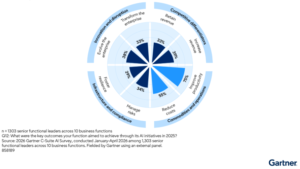
Source: Gartner (September 2026)
Popular AI Use Cases Rarely Deliver the Highest Returns
The most widely pursued AI use cases are rarely the ones delivering the highest positive returns. Functional leaders are frequently falling into the trap of prioritizing “popular” or heavily hyped AI applications over those that generate tangible value.
When contrasting the top three use cases pursued with AI versus the top three use cases with the largest proportion of leaders reporting positive returns, a clear disconnect emerges for IT. Cybersecurity threat detection and response (54%), IT service desk automation (54%) and automated code generation and refactoring (44%) were all identified as the most frequently pursued AI use cases by C-suite leaders. However, intelligent IT asset and cost optimization (40%), synthetic data generation (28%) and automated code generation and refactoring (23%) were identified as the top three AI use cases with positive returns.
“Organizations are seeing the greatest quantifiable value from less common, strategically selected use cases that are closely aligned to their unique business needs,” said Nunno. “CEOs and CIOs must pinpoint which AI use cases truly drive positive financial returns, so they can set clear, effective targets for every function and leader.”