


As AI sourcing decisions increasingly influence where enterprise intelligence, expertise and capabilities reside, chief procurement officers (CPOs) must manage AI capabilities, not just suppliers, according to Gartner, Inc., a business and technology insights company.
With AI becoming embedded in software, services, infrastructure and autonomous agents, CPOs are influencing much more than supplier selection. They are increasingly shaping how work is performed, where expertise resides and how future capabilities develop across the enterprise.
“Organizations are no longer acquiring AI through a single supplier market or spend category,” said Katarzyna Fonteyn, Director Analyst, IT Services, in Gartner’s Supply Chain practice. “AI capabilities are being purchased across the enterprise, often without a unified view of how those investments relate to one another. Treating AI as a dedicated category management domain helps organizations improve visibility, strengthen governance and make more deliberate decisions about where critical capabilities should reside.”
Traditional category management was designed around supplier markets, contracts and spend categories, but AI increasingly cuts across those boundaries. Organizations acquire AI capabilities through software, cloud platforms, infrastructure, consulting services, embedded applications and business-led purchases. This creates common challenges around governance, risk management, data rights and value realization, regardless of where the AI spending originates.
As AI assistants and autonomous agents become part of day-to-day operations, CPOs have a growing role in determining how capabilities are distributed across employees, suppliers and digital workers. This necessitates a move away from a traditional IT category management approach to a dedicated AI category management strategy (see Figure 1).
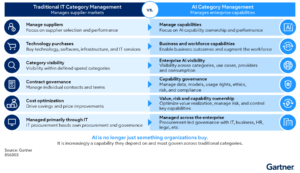
Source: Gartner (August 2026)
Managing AI as an Enterprise Capability
Organizations also face consumption growth that can outpace governance, limited pricing transparency, inconsistent data rights protections and AI investments made ahead of the organizational maturity needed to effectively manage them.
Gartner recommends that CPOs take several steps to improve visibility, governance and control as AI becomes an enterprise capability:
- Create enterprise-wide visibility into AI capabilities, spend, suppliers and use cases
- Treat AI as a category management domain rather than solely a technology category
- Establish enterprise standards for AI acquisition, governance, data rights and risk management
- Measure AI investments against business outcomes and workforce impact
- Make deliberate decisions about which AI capabilities should be built, bought or managed through a blended approach