
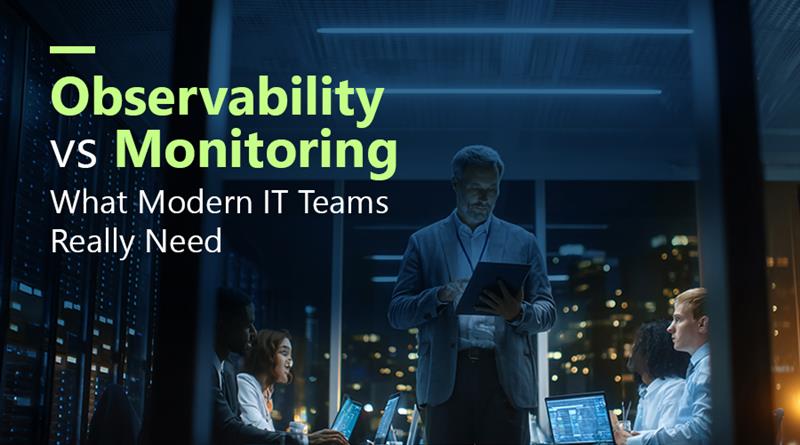
IT environments have changed dramatically. From monolithic applications hosted on a single server, we’ve moved to microservices, distributed systems, hybrid clouds, containers, serverless workloads, and APIs everywhere. In this landscape, traditional monitoring, which was once the backbone of IT reliability, is no longer enough. IT teams today need observability.
But what exactly is the difference between the two? And what should modern IT teams prioritize? Let’s break it down.
Monitoring: The Basics of “Knowing Something Is Wrong”
Monitoring is the practice of collecting predefined metrics to track the health and performance of systems. It answers questions like:
- Is the CPU usage too high?
- Is memory about to run out?
- Is the application returning errors?
- Is the database up?
Monitoring relies on dashboards, thresholds, and alerts. You define what “normal” looks like and get notified when something goes wrong.
Where Monitoring Works Well?
Monitoring shines when:
- Systems are predictable
- Failure modes are known
- Infrastructure is static (VMs, on-prem servers)
- Only basic uptime checks and performance indicators are required
But in dynamic, distributed, cloud-native environments, the story changes.
Why Monitoring Alone Fails in Modern IT?
Modern IT systems are complex. They’re spread across many services, change constantly, and depend heavily on each other. Because of this:
- Things break in ways you didn’t expect
- Containers and microservices come and go quickly
- One small issue can cause a chain reaction
Traditional monitoring can tell you that something is broken, but not why. This is where observability comes in.
Observability: The Ability to Understand “Why It’s Wrong”
Observability is about understanding the internal state of your system using logs, metrics, and traces, even when you didn’t know what failure to expect. Instead of relying only on dashboards, observability gives your team the ability to ask new questions about your system without writing new code or adding new alerts.
Observability answers critical questions such as:
- Why is latency increasing?
- Which microservice is slowing down the user journey?
- Where did the request fail?
- What was the sequence of events that led to the outage?
- How can we prevent this from recurring?
In a nutshell, observability shifts IT from reactive to proactive.
| Traditional Monitoring | Modern Observability |
| Static dashboards | Exploratory analysis |
| Known issues | Unknown failures |
| High-level alerts | Deep service-level insights |
| Reactive troubleshooting | Predictive, proactive prevention |
| Siloed monitoring tools | Unified telemetry across systems |
Why Modern IT Teams Need Observability?
- Cloud-Native Complexity: Microservices, Kubernetes, serverless; all introduce new points of failure. Distributed tracing becomes essential to follow a request across multiple services.
- Faster Troubleshooting: Observability tools help teams diagnose issues in minutes instead of hours.
- Better Performance Optimization: You can see exactly which components slow down the system, enabling targeted improvements.
- Improved Developer Experience: Engineers get actionable data, not alert fatigue.
- Smarter Automation: With quality telemetry, modern AIOps tools can:
- Detect anomalies
- Predict outages
- Recommend remediation steps
Real-World Example: Monitoring vs. Observability
Imagine a retailer running dozens of microservices during a festive sale.
Monitoring View
Your dashboard shows:
- 500 errors spiking
- CPU high on Service A
- Database connections maxed out
You know something is wrong but not what caused the chain reaction.
Observability View
With distributed tracing and correlated logs:
- You see that Service C is taking 1.2 seconds longer
- That delay is causing timeouts in Service B
- Which leads Service A to retry requests endlessly
- Overloading the database
Observability gives you causality, not just symptoms.
Can Monitoring and Observability Coexist?
Absolutely. Monitoring is still essential. You still need:
- Uptime metrics
- Basic performance thresholds
- SLA/SLO tracking
- Infrastructure health dashboards
But observability builds on top of monitoring to give a complete, real-time understanding of system behavior. Monitoring tells you when something is wrong. Observability tells you why.
Final Thoughts
As IT systems become more distributed and dynamic, the gap between monitoring and observability becomes wider. Monitoring is necessary but not sufficient. To deliver resilient, high-performing digital experiences, IT teams need the ability to understand, analyze, and debug complex systems in real-time.
Observability is no longer a “nice to have.” It is foundational to modern IT.
If you’d like to explore how observability can strengthen your IT landscape, feel free to write to us at marketing@cloverinfotech.com