
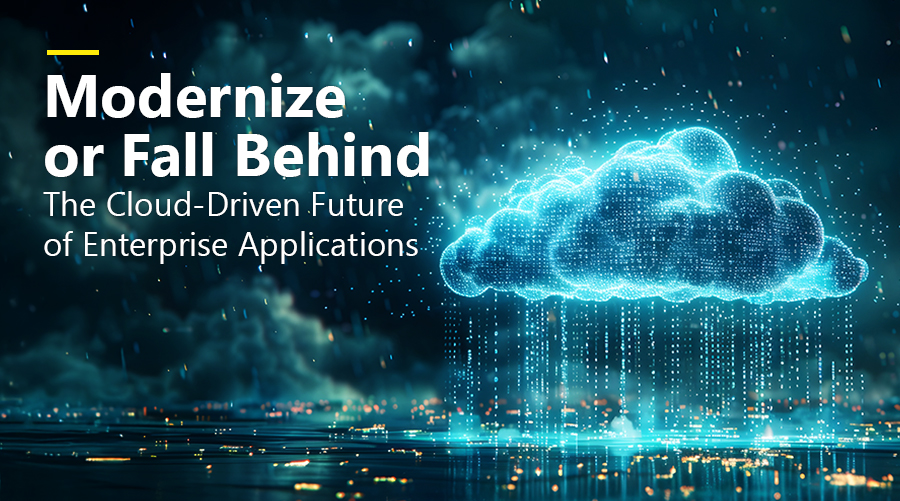
In today’s hyper-competitive, digital-first economy, enterprise applications are no longer just systems of record, but they are systems of differentiation. Organizations that continue to rely on heavily customized, on-premise legacy platforms are finding it harder to scale, innovate, and respond to market changes. Cloud-driven modernization is no longer a strategic option; it is a business imperative.
Why Legacy Enterprise Applications Are Holding Businesses Back
For decades, on-premise ERP, CRM, and core business applications formed the backbone of enterprises. While reliable in their time, they now present structural limitations.
Key challenges organizations face today:
- High infrastructure and maintenance costs with limited ROI
- Slow innovation cycles due to rigid architectures
- Complex upgrades that disrupt business operations
- Limited scalability during demand spikes
- Security and compliance risks with aging platforms
As customer expectations evolve and regulatory demands increase, these constraints can quickly become growth blockers.
The Cloud Shift: From IT Upgrade to Business Transformation
Cloud adoption is no longer about moving servers, it’s about transforming how enterprises operate, decide, and grow. Modern cloud platforms enable organizations to reimagine their applications with agility, intelligence, and resilience at the core.
Cloud-driven enterprise applications offer:
- Elastic scalability to support growth without overprovisioning
- Lower total cost of ownership (TCO) through pay-as-you-go models
- Continuous innovation with frequent feature updates
- Built-in security and compliance aligned to global standards
- Faster time-to-value for new initiatives
More importantly, the cloud enables IT teams to shift focus from maintenance to innovation.
Modern Enterprise Applications: What’s Changing?
Modernization is not a lift-and-shift exercise. It is a strategic redesign of applications to align with today’s digital business needs.
- From Monoliths to Modular Architectures
- Cloud-native applications are built using microservices and APIs
- Enables independent scaling, faster releases, and easier integrations
- Reduces dependency on a single, rigid codebase
- Intelligence Embedded by Design
- AI and analytics are now core capabilities, not add-ons
- Real-time insights drive smarter decisions across finance, supply chain, and operations
- Automation reduces manual effort and human error
- Continuous Innovation Over Periodic Upgrades
- Traditional upgrades every few years are replaced by continuous updates
- Businesses benefit from new features without disruption
- IT teams avoid upgrade fatigue and regression risks
Business Outcomes That Matter
Organizations modernizing their enterprise applications are seeing tangible business benefits:
- Improved operational efficiency through automation and standardization
- Better decision-making with real-time, unified data views
- Enhanced user experience across web and mobile platforms
- Faster go-to-market for new products and services
- Stronger business resilience in uncertain economic conditions
Modern platforms turn IT into a growth enabler rather than a cost center.
Modernization Is a Journey, Not a One-Time Project
A successful modernization strategy typically follows a phased approach:
- Assess & rationalize existing applications and customizations
- Modernize where it matters most—finance, supply chain, customer experience
- Adopt hybrid models where full cloud migration isn’t immediately feasible
- Build integration-first architectures to connect legacy and modern systems
- Upskill teams to operate and innovate in a cloud-first world
This ensures continuity while steadily unlocking long-term value.
The Risk of Standing Still
The biggest risk enterprises face today is not migration failure, it’s inaction. Organizations that delay modernization often struggle with:
- Inability to adopt AI and automation at scale
- Slower response to customer and market demands
- Rising technical debt and operational costs
- Competitive disadvantage against cloud-native peers
In contrast, cloud-first enterprises are setting new benchmarks in efficiency, innovation, and customer experience.
Conclusion: The Future Is Cloud-Driven
Enterprise applications are entering a new era which is defined by agility, intelligence, and continuous evolution. Cloud-driven modernization empowers organizations to move faster, operate smarter, and compete more effectively in an increasingly digital world.
Enterprises must modernize now or risk falling behind. The future of enterprise applications belongs to those who embrace the cloud, not just as a platform but as a catalyst for business transformation.
Start your enterprise modernization journey today.
Connect with our experts to assess your current landscape, identify quick wins, and build a future-ready cloud strategy that aligns with your business goals.
Write to us at marketing@cloverinfotech.com