


Finance functions are rapidly moving AI from experimentation into production, but many CFOs are still struggling to convert AI deployment into significant business value, according to Gartner, Inc., a business and technology insights company.
Speaking at the Gartner Finance Symposium/Xpo 2026 in National Harbor, Marco Steecker, Director Analyst, Research in the Gartner Finance practice, said finance’s 2026 AI “report card” shows that AI adoption is advancing, but realized value is not keeping pace with CFO expectations.
Figure 1. Realized Vs Expected Value from AI Tools
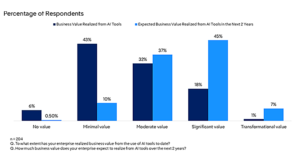
Source: Gartner (May 2026)
Report Card Shows Progress and Value Gaps
Finance’s lower grades are concentrated in implementation speed and analytics impact. Gartner found that 63% of finance organizations said AI implementation was slower than expected in 2025. Analytics-related use cases also remain difficult to convert into high impact, with financial forecasting and insight generation among the lowest-rated use cases.
“Finance leaders see the potential of AI analytics, but too many initiatives are still aimed at incremental improvements rather than material business problems,” said Steecker. “The best opportunities are in areas that matter to the business and are difficult to diagnose using traditional methods.”
To improve finance’s AI grade, Gartner recommends CFOs measure AI portfolio progress by realized value rather than deployment volume, rebalance investments beyond productivity-led use cases, address stall points such as cost overruns and rigid team mindsets, and prepare for embedded AI assistants and AI-enabled simulation by strengthening data, talent, process and governance foundations.
“Finance does not need to prove that it can use AI anymore,” said Steecker. “It needs to prove that AI can change how finance supports better business decisions.”