
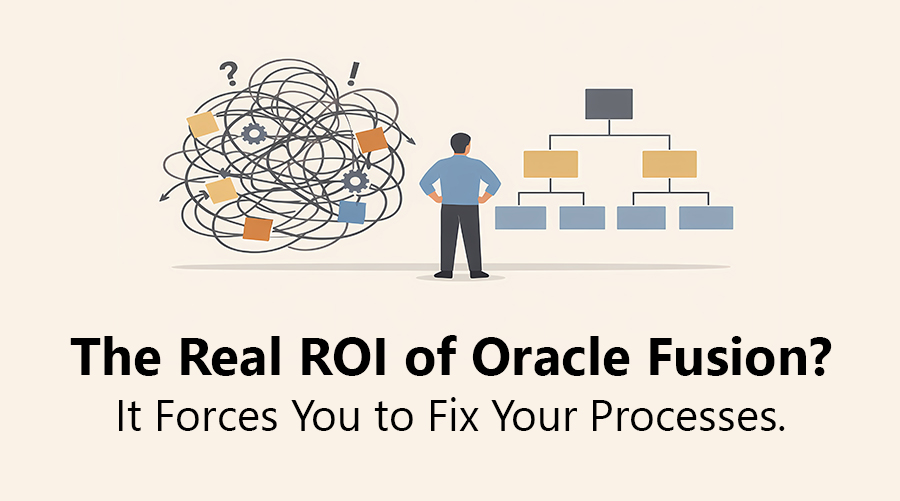
Every few months, a new wave of organizations have announced their plans to implement Oracle Fusion. The pitch is always compelling: unified data, intelligent automation, real-time reporting, a single source of truth. The ambition is real. The investment is significant. And far too often, the outcome is disappointing. Not because Fusion failed to deliver, but because no one told leadership what the system would find when it got there.
Oracle Fusion is not a transformation engine. It is a precision instrument. And precision instruments are brutally honest.
The system doesn’t absorb dysfunction, it rejects it
Legacy systems, for all their faults, were often forgiving. Years of customization, workarounds, and shadow processes built up like scar tissues that are ugly, but functional. Data lived in spreadsheets alongside the system. Approvals happened over email, then got back-entered. Exception handling became the rule.
Fusion doesn’t accommodate that. Its workflow engine assumes clean handoffs. Its approval hierarchies assume roles are defined. Its intercompany accounting assumes your legal entity structure makes sense. The moment you try to map a broken process onto a well-architected system, the seams show immediately.
Three things Fusion will expose before go-live
- Who actually owns what.Fusion’s role-based access control forces the question every organization avoids: who is accountable for this decision? If three people think they approve the same purchase order, Fusion will surface that conflict immediately.
- Whether your data is trustworthy.The promise of Fusion’s analytics is only as good as what you bring in. Master data quality of vendors, cost centers, item catalogs, and customer records tends to be far worse than anyone expects. The migration process doesn’t clean data; it reveals how dirty it already was.
- Where your processes were held together by people, not design.In legacy environments, certain employees became indispensable precisely because they knew how to navigate broken workflows. Fusion’s standardization removes those workarounds and suddenly the process that “always worked” stops working, because it was never really a process at all.
This is a feature, not a flaw
Organizations that expect Oracle Fusion Cloud ERP to quietly absorb their existing complexity often run into trouble. Those that treat the implementation as an opportunity for structured process review come out far stronger. The real value lies in that exposure, because the inefficiencies and workarounds were always there; Fusion simply makes them impossible to ignore.
The most effective leaders approach an ERP program with a different lens. Instead of asking, “How do we configure Fusion to replicate what we do today?” they ask, “Which of our current practices no longer make sense?” That shift in thinking is what separates an expensive lift-and-shift from meaningful, long-term transformation.
What to do before you begin configuration?
Before you configure a single screen in Oracle Fusion, pause and assess your readiness. Most ERP failures aren’t technology failures. They’re process failures disguised as technology issues.
Start with a structured process readiness assessment before the system integrator touches anything. Map your current workflows in detail, surface every exception and workaround, and make an explicit call on each one: standardize it, eliminate it, or consciously carry it forward. Bring process owners into the conversation early, not just IT. And set the tone from the top, because some of what the system uncovers will be uncomfortable.
The organizations that succeed with Fusion aren’t the ones with the cleanest legacy environments. They’re the ones willing to confront reality. They let the system reveal what’s broken and act on it.
Let’s talk
At Clover Infotech, we work with organizations to get this part right “before” implementation begins; bringing clarity to processes, aligning stakeholders, and ensuring your Oracle Fusion journey delivers real transformation, not just system go-live.
If you’re planning your Fusion initiative, let’s start with a conversation on readiness. Write to us at marketing@cloverinfotech.com