


Self-Managing, Autonomous Supply Rooms to Alleviate Staffing and Operational Burdens
“Hospitals have spent years buying technology that helps employees count supplies, but employees are still doing the counting,” said Bruce Gilmore, VP Analyst in Gartner’s Supply Chain practice. “AI and computer vision create an opportunity to remove that work, rather than make it incrementally faster. This can enable nurses to spend more time with patients, rather than searching for missing items in stockrooms.”
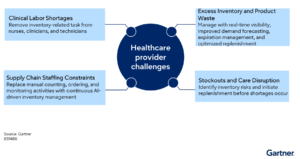
Gartner research points to a number of benefits to implementing autonomous supply rooms, including providing administrators with a real-time view of available supplies and enabling the management of a wider range of growing products at scale. Additionally, autonomous periodic automatic replenishment (PAR) rooms can help directly address four ongoing challenges facing healthcare providers today (see Figure 1).
Figure 1: Autonomous Periodic Automatic Replenishment (PAR) Rooms Address Four Challenges
Source: Gartner (August 2026)
AI and Computer Vision Enable Self-Managing Inventory
Gartner recommends that healthcare organizations avoid allowing prior investments to dictate future strategy and evaluate technologies according to how much manual work they eliminate, their long-term operating costs and their ability to scale inventory autonomy across clinical inventory locations.
“CSCOs should evaluate new technology investments in this area by the work they remove,” said Gilmore. “The relevant measures are whether supply chain employees spend less time counting, clinicians find supplies faster, fewer products expire and shortages occur less often.”