

By 2029, 30% of employees who were terminated and replaced by AI will be rehired, often at a higher cost, as organizations struggle to align workforce decisions with evolving business needs, according to Gartner, Inc.
According to a July 2026 Gartner survey of 297 CHROs, only 19% of organizations have workforce planning practices that effectively help leaders understand how work is changing, account for AI’s impact, and realign talent strategies with business goals. Yet organizations with effective workforce planning are 1.4 times more likely to exceed revenue goals and 1.5 times more likely to exceed cost goals.
During Gartner HR Symposium/Xpo, McDonough shared a new enterprise framework for strategic workforce planning.
Moving Beyond Traditional Workforce Planning
Gartner has created a new framework that considers the enterprise strategy first and aligns workforce decisions to the work required to achieve strategic goals.
There are five planning phases:
- Identify the workforce capabilities most critical to executing business strategy
- Forecast future work demand and capacity requirements
- Assess future workforce supply, including both human and AI-enabled capacity
- Quantify workforce gaps and evaluate potential solutions based on cost, risk and speed
- Establish governance to prioritize and fund workforce investments
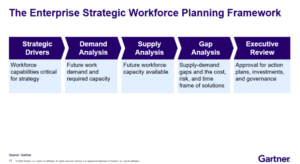
Source: Gartner (October 2026)
Enterprise strategic workforce planning ultimately enables CHROs to tell the CEO and board what work and workforce capabilities are most important to strategy, what type of workforce they will need in the future, and what will it take to deliver the workforce.
Rather than attempting an enterprise-wide rollout from the outset, CHROs should partner with leaders to pilot the framework for 1-2 business capabilities and then scale their approach based on lessons learned.
“To prepare for an AI-driven future, leaders should stop planning for the workforce they have and start planning for the workforce their strategy requires.,” said McDonough. “When organizations shift the focus from jobs to work and work demand, they avoid costly workforce missteps and allocate resources more effectively.”