
For years, enterprise systems have been great at one thing i.e. showing us what already happened. Monthly reports, quarterly forecasts, dashboards; all well-organized, but by the time decision-makers see them, they’re often slightly outdated.
That’s the fundamental shift we’re witnessing today. Businesses no longer want to understand the past. They want to anticipate what’s next. And this is where AI inside Oracle Fusion Cloud Applications is quietly, but profoundly, changing the game.
The End of Passive Reporting
Traditional reporting has always been reactive. You close your books, generate reports, analyze variances, and then decide what to do. But by the time a CFO reviews a variance report, the underlying issue may have already escalated. By the time HR identifies attrition trends, key talent may already be out the door. Static reports, no matter how detailed, operate on a delay.
Oracle Fusion is moving beyond this paradigm by embedding AI directly into business workflows, not as an add-on, but as a native capability. The result? Systems that don’t just inform; but actively guide.
From Insight to Foresight
What makes this shift meaningful is not just automation, it’s prediction.
Instead of asking:
- What happened last month?
Organizations can now ask:
- What is likely to happen next and what should we do about it?
Within Oracle Fusion, AI models continuously analyze historical patterns, real-time inputs, and contextual signals to generate forward-looking insights.
In finance, this could mean:
- Predicting cash flow gaps before they occur
- Flagging unusual transactions in real time
- Suggesting corrective actions during the close process
In HR:
- Identifying employees at risk of attrition
- Recommending personalized career paths
- Highlighting skill gaps before they impact delivery
In supply chain:
- Anticipating demand fluctuations
- Recommending inventory adjustments
- Detecting potential disruptions early
This isn’t just analytics, its decision intelligence embedded into operations.
AI That Works Where You Work
One of the biggest barriers to AI adoption has always been usability. Insights locked in dashboards often go unused because they sit outside the flow of work. Oracle Fusion takes a different approach. AI is embedded directly into the applications people already use such as finance screens, HR workflows, procurement systems.
This matters more than it sounds. Because when insights appear in context, decision-making becomes faster and more intuitive. A procurement manager doesn’t need to open a separate analytics tool to identify a risky supplier. The system flags it instantly, within the transaction itself.
This shift from separate analytics to embedded intelligence is what truly drives adoption.
The Rise of Intelligent Recommendations
Another subtle but powerful evolution is the move from alerts to recommendations. Alerts tell you something is wrong. Recommendations tell you what to do next. Oracle Fusion’s AI capabilities are increasingly focused on the latter:
- Suggesting optimal payment terms
- Recommending candidates for open roles
- Proposing next-best actions in sales or procurement
This reduces decision fatigue and helps teams act with greater confidence, especially in complex environments where variables are constantly changing.
Trust, Transparency, and Control
Of course, with AI-driven decisions comes an important question: Can we trust the system?
Oracle Fusion addresses this by emphasizing explainability and governance. Users can understand why a prediction was made, what data was considered, and how confident the system is.
This is critical. AI shouldn’t feel like a black box, it should feel like a well-informed advisor. Organizations still retain control, but now they’re supported by systems that continuously learn and improve.
A Cultural Shift, Not Just a Technology Shift
While the technology is impressive, the real transformation lies in how organizations use it.
Moving from reports to predictions requires a mindset shift:
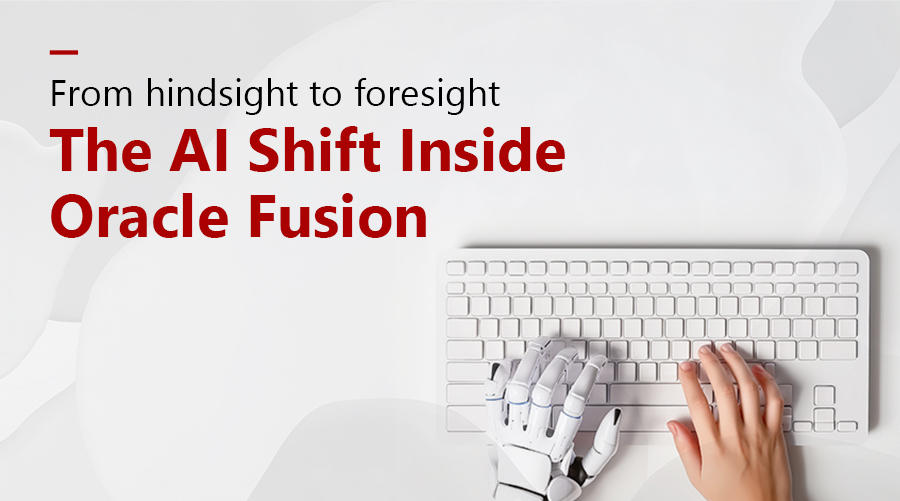
- From hindsight to foresight
- From analysis to action
- From periodic reviews to continuous decision-making
Leaders who embrace this shift are not just adopting new tools, they’re redefining how decisions are made across the enterprise.
Looking Ahead
We’re still in the early stages of this evolution, but the direction is clear. Enterprise systems are no longer just systems of record. They are becoming systems of intelligence. And in platforms such as Oracle Fusion, AI is not a feature, it’s becoming the foundation.
The organizations that will lead in this new era won’t be the ones with the most data. They’ll be the ones that can turn that data into timely, predictive, and actionable insight. Because in today’s world, knowing what happened is useful. But knowing what’s about to happen and acting on it, that’s where the real advantage lies!
Let’s Talk
At Clover Infotech, we’re helping enterprises move from hindsight to foresight with AI-driven Oracle Fusion. If you’re exploring what this shift could look like for your business, let’s connect.
Write to us at marketing@cloverinfotech.com and we’ll arrange a no-obligation call with our Oracle Fusion experts.